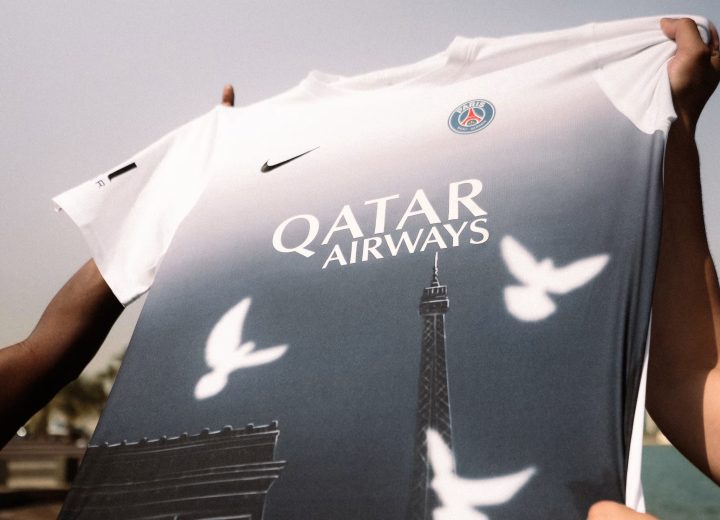
PSG × Astro Boy: from shirt to sculpture.
Leblon Delienne’s numbered figures turn a football kit into a miniature scene of belonging. An object reading beyond the drop announcement.
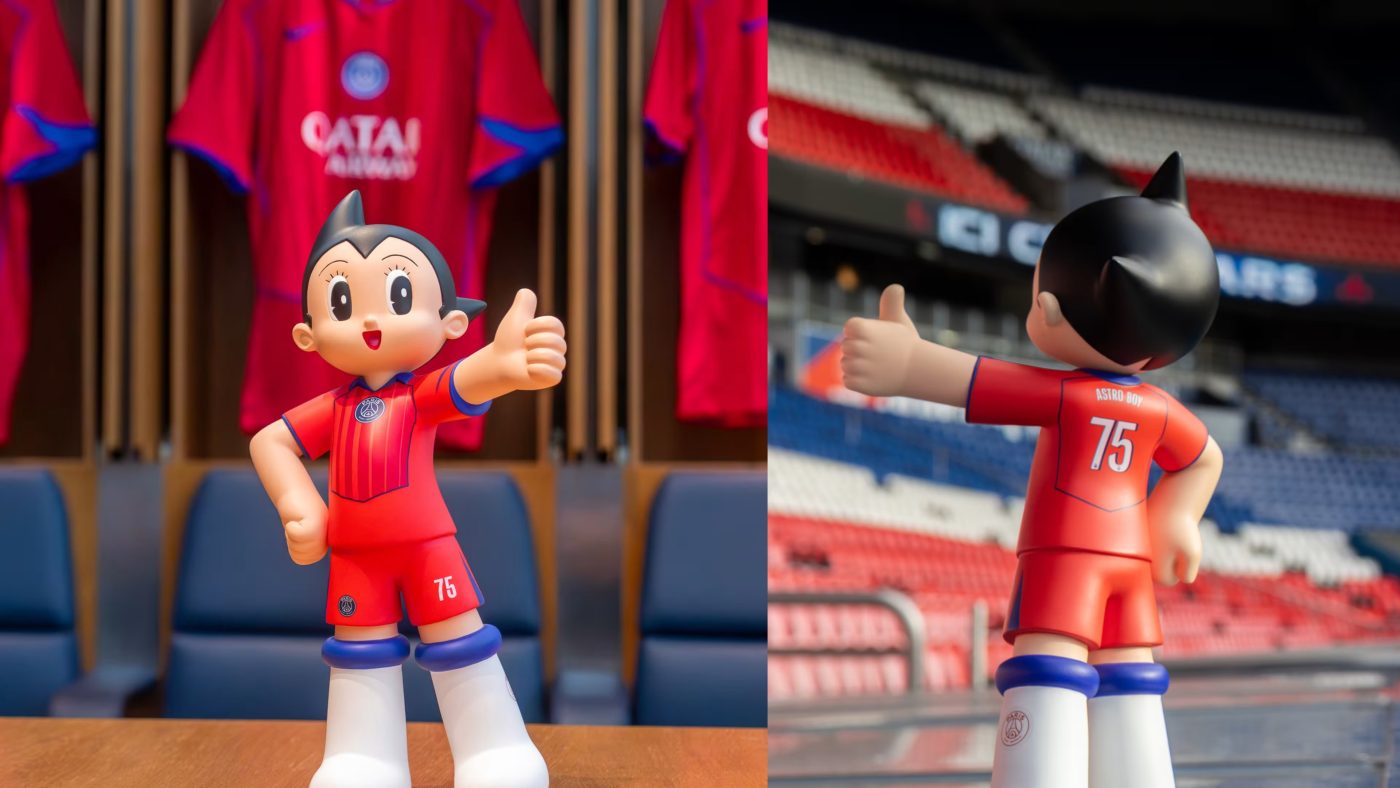
A football shirt is made to be inhabited. Place it on a sculpted character and the relationship reverses: the shirt becomes part of a fixed image. The body no longer belongs to a player or supporter. It belongs to a familiar figure from another visual world. That shift is the starting point for reading PSG’s Astro Boy objects.
The object record
PSG’s 2025 announcement identifies Leblon Delienne as the collaborating French sculpture workshop. It describes two Astro Boy variants, each limited to 250 numbered copies: one wearing the 2025–26 Third kit, the other the 2024–25 Jordan Wings Fourth kit. It follows a first collaboration in 2024. The announced preorder windows were October and December 2025; those historical dates do not establish stock today.
A kit becomes a surface
PSG’s launch photographs place the sculpted character against the club’s shirts and stadium. The miniature carries a recognisable kit, while its fixed pose changes the way that kit is seen. Three elements deserve separate attention: the character carrying the shirt, the variant distinguishing the edition, and the number locating one example within a run.
Those elements do different jobs. A familiar character invites recognition. A shirt connects that recognition to a club and season. Numbering introduces a relationship between an individual object and a larger set. Confusing these roles makes a limited edition sound more culturally meaningful than its design alone can establish.
The small scale of a large memory
A miniature can condense a much larger scene. The shirt points outward to the stadium and the group, while the object is encountered privately on a shelf. This contrast matters: the figure converts a collective sporting identity into something that can be placed beside books, artworks or other designed objects.
The art question is how the object holds several references together. Look for the boundary between character and clothing. Does the kit read as a changeable costume, or does it appear inseparable from the sculpted body? Does the edition make you look at pose and silhouette, or only at the shirt’s graphic details? The official images linked below allow that inspection.
What numbering does not tell us
An edition size is useful documentation. It is not evidence of artistic significance, demand or future value. A careful record also needs the named maker, material, measurements, variant and condition. If an object comes with a certificate, keep that record distinct from the visual reading of its form.
The difference from our Hechter essay is revealing. A stripe can survive as a repeatable visual grammar; a numbered sculpture asks to be understood as one member of a finite set. PSG’s cultural world includes both. Reading the contrast gives the collection more depth than another announcement of what has just gone on sale.
Sources & image credits
Primary records for the dates, makers and projects discussed above. Photographs and artwork images are credited in their captions, with links to the original publication or portfolio.
Record checked 4 October 2026. Historical launch specifications are identified by date; product availability is not implied. The critical readings are BENI HASAN’s.