Ilia Topuria × Maseda: A Championship Portrait, Hand-Finished
The making of Topuria and Maseda’s IT’S TIME: a hand-finished portrait reproduction, a 1,000-unit boxed edition and the 2024 fight behind it.
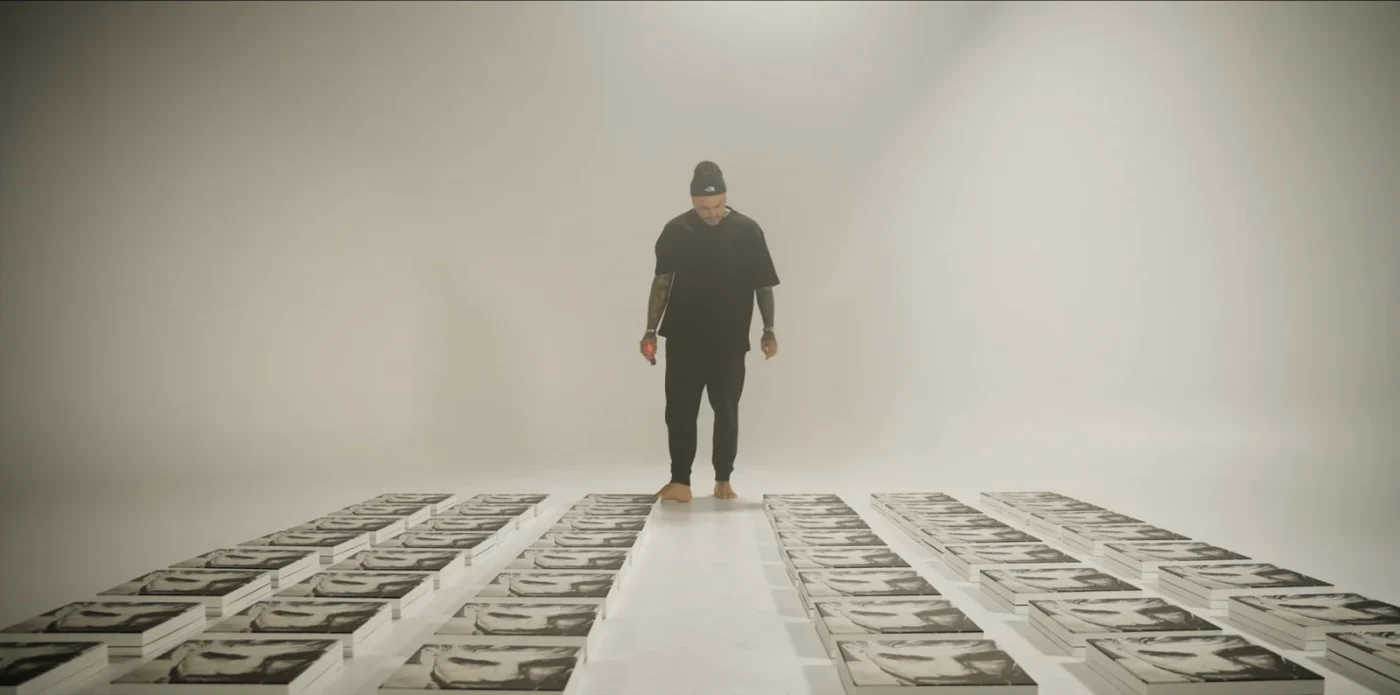
Ilia Topuria’s first UFC title victory has a life beyond the highlight reel. His collaboration with Spanish artist Maseda, IT’S TIME, takes a portrait made around that breakthrough and turns it into an art edition for fans.
Topuria supplies the face and the sporting story. Maseda brings a visual language built around portraiture, monochrome and fluorescent pink. The pairing carries the intensity of a championship breakthrough into a format made to stay on the wall.
The fight behind Ilia Topuria’s Maseda portrait
On February 17, 2024, Topuria knocked out Alexander Volkanovski at UFC 298 in Anaheim to win the featherweight championship. The portrait’s origins lead back to that 2024 breakthrough.
According to Topuria’s official store, Maseda made the portrait in the hours before the title-winning fight and shared it on social media after the victory. A proposed T-shirt collaboration developed into something more substantial: a boxed edition built around a reproduction that the artist would retouch by hand.
Who is Maseda?
Marco Gómez Maseda is an artist from Castellón, Spain, whose work brings street-art influences into expressive portraiture. Black and white establish the face; fluorescent pink cuts through that restrained palette. His own biography describes an interest in the emotional lives of his subjects, giving his portraits a psychological direction.
That matters when the subject is a fighter. Combat-sport imagery often has to communicate power immediately: a stare, a pose, a belt. An artist can slow that encounter down. A portrait asks viewers to spend time with a face after the noise of the event has passed. Its job is to hold attention on the wall, with no walkout music to help it.
The portrait sits within a broader practice rather than a one-off sporting detour. Maseda’s portfolio returns to the face as a site of tension and expression. The subject changes; his collision of monochrome and fluorescent colour remains recognisable.
What is in the Topuria × Maseda edition?
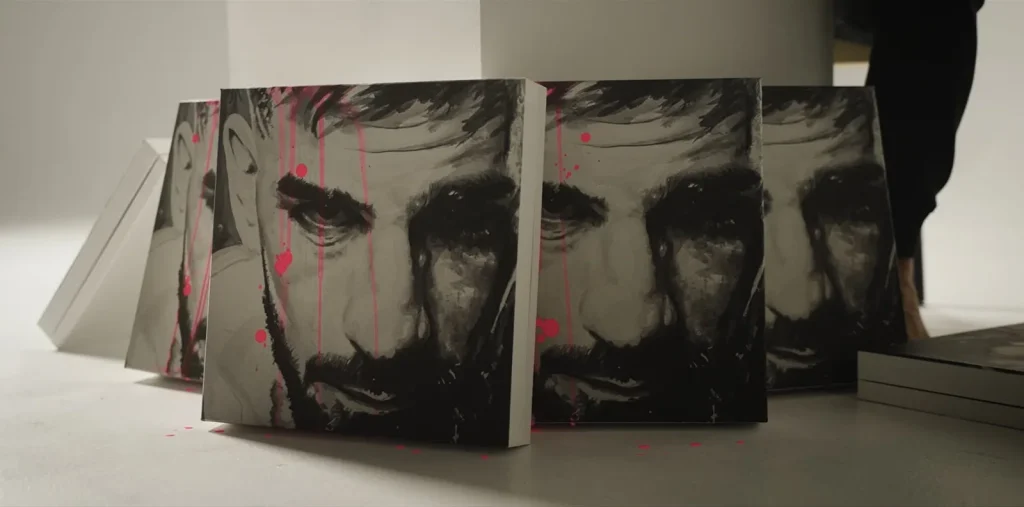
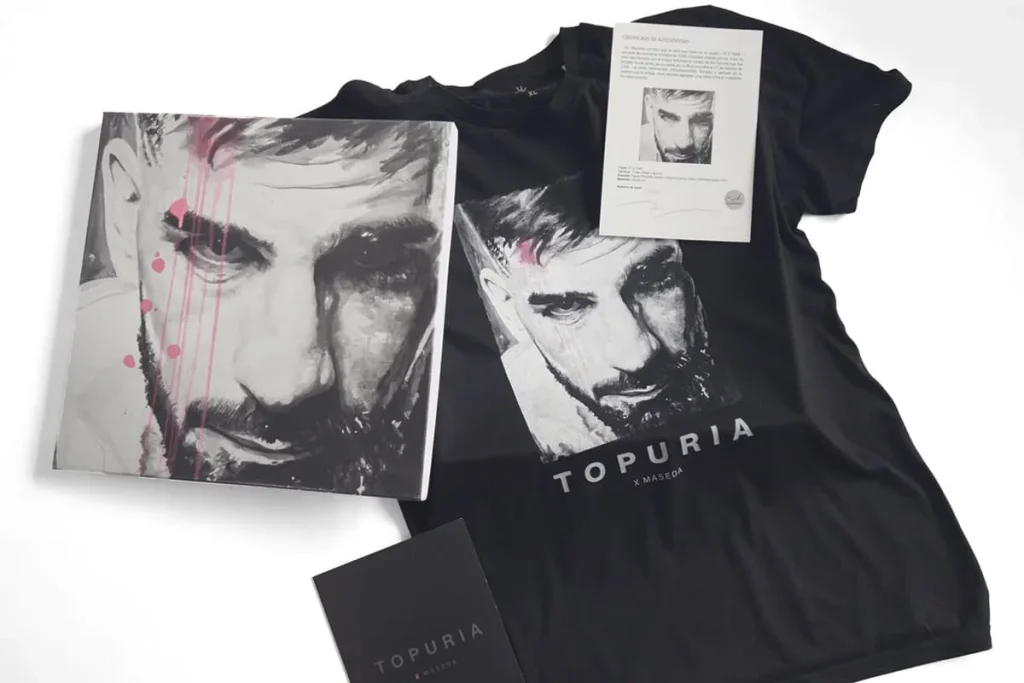
The official listing describes a run of 1,000 boxed units. Each contains a reproduction of the portrait retouched individually by Maseda, supplied ready to hang, alongside numbered authentication, a certificate and a collection T-shirt. The page listed the package at €350 when checked on 4 October 2026; availability and pricing should be checked directly with the store.
This is a hand-finished reproduction: a printed starting point that Maseda returns to individually. The edition number identifies the run, while the certificate records the object’s authenticity. For fans used to numbered sports collectibles, those details are a familiar way into the language of art editions.
From printed portrait to boxed edition
Swipe or use the arrows to explore.
Reading the portrait as a portrait
The pairing works because a face can hold two kinds of recognition at once. A UFC fan sees Topuria and remembers the fight. Someone encountering Maseda for the first time can follow the contrast between the dark passages, pale face and sharp pink interruptions. Both readings begin in the same image, then travel toward different details.
Monochrome concentrates attention on the structure of a face: the eyes, the jaw, the shadows that give a head its weight. Fluorescent colour introduces another pace. It can cut across an otherwise convincing likeness and make the surface feel restless. That tension gives the portrait an energy that survives outside the sporting event. The image carries a person’s identity and a painter’s handling of it.
The edition is part of the artwork’s story
A run of 1,000 establishes a shared image across many objects. The hand-finishing adds decisions made after the reproduction stage. The official description does not set out a separate visual specification for every box, so individual differences should be understood through the artist’s intervention rather than assumed from the edition number alone. Numbering identifies an example; it does not rank it.
The T-shirt takes the image into another setting. On fabric, a portrait becomes something a supporter can wear and carry into daily life. The framed reproduction asks for a more settled encounter at home. Putting both in one box gives the collaboration two routes into the same audience, with Maseda’s visual language connecting them.
The official specification lists offset and acrylic inks on Tintoretto Gesso 140 g/m² paper, mounted on 2 mm laminated cardboard. The edition’s physical appeal lies in that sequence: reproduction, mounting and the artist’s hand intervention. It should be understood as a hand-finished reproduction rather than a run of 1,000 original paintings.